
Gold's glittering rally is expected to continue, with prices likely to climb towards $4,500 per ounce in overseas markets, supported by sustained global central bank purchases, persistent geopolitical tensions, and strong Asian demand, according to a report by Motilal Oswal Financial Services Ltd. Silver, which has outperformed gold in terms of returns so far this year, is projected to climb to around $75 per ounce, aided by robust industrial consumption and a widening supply deficit, the report said.

New Delhi will substantially reduce tariffs on industrial and agricultural goods while continuing to protect sensitive sectors. Tariffs on some agricultural products that are not traditionally considered sensitive will be brought down to zero, while in the case of relatively sensitive items, duties will be reduced in a graded manner and quotas will be imposed.
The fiscal deficit for FY25 has been pegged at 4.8 per cent of GDP and at 4.4 per cent for FY26, Finance Minister Nirmala Sitharaman said on Saturday. Presenting the Budget 2025-26, she said net market borrowings are estimated at Rs 11.54 lakh crore for next fiscal year.

India is growing fast, but to keep growing strong, the government must make more things at home, create jobs, and spend money wisely, suggests Rajiv Memani, regional managing partner, Africa-India Region, EY.

The ministries of Road Transport & Highways and Railways have exceeded the national average capital expenditure (capex) by spending 63 per cent and 57 per cent of Budget estimates (BE), respectively, in the first half of 2025-26 (FY26). The total capital expenditure for April-September of FY26 stood at 52 per cent of the BE, according to the latest data by the Controller General of Accounts (CGA).

Reserve Bank of India (RBI)Governor Sanjay Malhotra on Friday said it was not the regulator's job to take decisions for bank boards, speaking in the context of the wide range of enabling reforms announced for lenders during the October monetary policy review, and emphasised that financial stability remained the regulator's focus.

'This Budget has a one-year agenda, which you can call the sprint, and the marathon is towards Viksit Bharat.'

The reduction in the goods and services tax (GST) rates has increased the momentum in India's economic activity both on the supply and demand sides, while robust agricultural activity - reflected in the strong onset of rabi sowing and adequate reservoir levels - has reinforced the outlook for food supply and rural incomes, the finance ministry said on Thursday.

A shift appears underway in India's tax landscape. States with relatively smaller tax collections like Odisha and Telangana are emerging as the fastest-growing contributors to indirect and direct tax collections, respectively.

'We kept this Budget on a larger plank, rather than on one incident, however serious.'

The power sector presents a puzzle. A fast-growing economy should be aligned to higher power demand but that hasn't been the case in the financial year 2026 till date (FY26TD).

The Reserve Bank of India (RBI) on Tuesday announced a fresh round of liquidity measures through open-market operations (OMOs) and a foreign exchange buy-sell swap, under which it will inject close to Rs 3 trillion into the banking system. The central bank said it would purchase Government of India securities worth Rs 2 trillion through OMOs, spread across four tranches of Rs 50,000 crore each to be conducted on December 29, January 5, January 12 and January 22.

'An asset must generate income. Equities yield dividends, bonds pay coupons, deposits give interest, and real estate earns rent.' 'Gold, silver, and even Bitcoin produce no income, they merely store value. So, they should not be compared to productive assets.'

'Calibrated depreciation will help rebalance external fundamentals, offset some of the tariff differentials with competitors, improve the competitiveness of domestic substitutes vis-a-vis Chinese imports, and contribute to the easing of financial conditions at a time when the inflation rate is unusually low,' explains Sajjid Z Chinoy, head of Asia Economics at JP Morgan.

Despite a strong 7.8 per cent growth in the first quarter, the Indian economy is expected to grow at 6.5 per cent in the current financial year as the impact of US tariffs on Indian exports will reduce prospects, particularly in the second half, ADB said on Tuesday.

The Indian economy recorded a six-quarter high growth of 8.2 per cent in July-September, as factories churned out more products in anticipation of a consumption boost from the GST rate cut, according to government data.

The government bond yield curve is likely to flatten in the financial year 2027 (FY27) as the Reserve Bank of India (RBI) is expected to ease supply pressure in the ultra-long segment. In FY26 so far, reduced investments by insurance companies and pension funds pushed up yields on ultra-long tenor securities, steepening the curve.

The government's capital expenditure in the April-November period of financial year 2024-25 (FY25) continued to contract with a 12.3 per cent decline year-on-year (Y-o-Y), according to data released by the Controller General of Accounts on Tuesday.

'Rate cut looks unlikely and there is reason to believe that the cycle is over.'

Vedanta, a conglomerate in mining and metals, has seen a surge in its share price on the back of multiple triggers. Its demerger appears to be on track, a strong non-ferrous commodity cycle is boosting margins, and silver bulls are interested in Hindustan Zinc, its subsidiary.

Continuing on the fiscally prudent path, the Modi government in the interim Budget refrained from announcing populist measures, which will help it trim the fiscal deficit to 5.1 per cent of the GDP next fiscal and 4.5 per cent in FY26.

The Indian metal market is a promising sector to invest in as it provides a good balance between the prospects of growth and stability in dynamic economic conditions and a changing geopolitical environment. Metals such as gold, silver, copper, etc, have gained renewed significance in 2025, amidst growing inflation and India's push towards infrastructural growth and green energy initiatives.
The Indian metal market is a promising sector to invest in as it provides a good balance between the prospects of growth and stability in dynamic economic conditions and a changing geopolitical environment. Metals such as gold, silver, copper, etc, have gained renewed significance in 2025, amidst growing inflation and India's push towards infrastructural growth and green energy initiatives.
The core dilemma remains: Why provide further stimulus to an economy that is already booming at an 8 per cent growth rate? asks Rajeswari Sengupta.

"The policy of Macaulay, which sowed the seeds of mental slavery in India, will complete 200 years in 2035. This means there are 10 years left. Therefore, in these very 10 years, we all must come together to free our country from the slave mentality," he said.

The central government's fiscal deficit during 2023-24 at 5.6 per cent of the GDP was better than previous estimates of 5.8 per cent on account of higher revenue realisation and lower expenditure, according to official data released on Friday. In actual terms, the fiscal deficit -- or gap between expenditure and revenue -- was Rs 16.53 lakh crore, or 5.63 per cent of the GDP, which grew 8.2 per cent in 2023-24.

'Any finality in such matters requires political views. We will review it closer to the full Budget.'

To ensure a glitch-free rollout of the next-generation GST with reduced rates and lesser slabs, Finance Minister Nirmala Sitharaman chaired three separate meetings to assess GSTN's preparedness and the time it would take to implement technological changes required in the software systems.

A string of welfare schemes and promises tests the state's budget, which is already heavily dependent on central support and spends little as capital outlay.
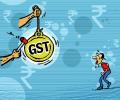
The State Bank of India (SBI) in its latest research report said that reforms in GST through reduction in rates will cause a minimal revenue loss of Rs 3,700 crore. The government estimates the net fiscal impact of GST rates rationalisation will be Rs 48,000 crore on an annualised basis.

India posted a current account surplus of $13.5 billion or 1.3 per cent of GDP in March quarter 2024-25 as compared with $4.6 billion in the year-ago period mainly on account of surge in services exports and higher remittances, according to RBI data released on Friday.

The Indian government has expressed its disagreement with the IMF staff's 'baseline' assumption that the 50 per cent US tariffs on its goods exports 'would remain in place indefinitely', based on which the staff pegged the country's GDP growth at 6.6 per cent this year, and pared its 2026-27 projection by 20 basis points to 6.2 per cent.

Funds raised by banks through certificates of deposit in December clocked the highest in the financial year 2023-24 as liquidity remained tight in the system with the Reserve Bank of India (RBI) infusing Rs 2.01 trillion on Monday, the highest in the current financial year. The liquidity deficit in the banking system widened to more than Rs 2 trillion on Monday on the back of advance tax outflows, market participants said. Around Rs 4 trillion worth of outflows are expected because of advanced tax and goods and services tax (GST) payments in December.

'Don't look at Russia only as a place to earn quickly and then leave.' 'Try to build experience in serious companies, skills and certifications that will serve you anywhere in the world.'

Experts say the state's economy is grappling with hidden debt, rising welfare costs, and lack of transparency.

India's trade deficit with Russia continued to widen for the second consecutive year to $57 billion in the financial year 2023-24 (FY24), with Moscow becoming New Delhi's largest source of crude oil imports. All eyes will now be on Prime Minister Narendra Modi's visit to Russia during July 8-9, where he is set to meet President Vladimir Putin. This will be Modi's first visit to the Kremlin since the Russia-Ukraine conflict began over two years ago.

Clarity on Tata Sons' position on listing, as of 2025, would help define the future of the group better, irrespective of the RBI stand. As of now, the ball is in the RBI's court, and everyone is watching the space, points out Nivedita Mookerji.

As one of the federal appeal courts in the United States ruled that most of tariffs imposed by Trump administration are not accordance with the laws, US President Donald Trump on Friday (local time) affirmed that all tariffs imposed on the countries will remain in effect, calling a recent ruling by a 'highly Partisan Appeals Court' incorrect.

AI will erase outsourcing jobs, redefine skills and disrupt global giants within five years, predicts Vinod Khosla. The IT legend urges young people to become generalists: Adaptable thinkers who can learn quickly, connect dots across disciplines and shift careers as technologies evolve.
In November, the fiscal deficit widened by Rs 2.2 trillion, the highest ever in any month this financial year.
